Butylparaben: A Manufacturer’s Perspective on a Familiar Preservative
Historical Development
From the mid-20th century, butylparaben found its way into global manufacturing due to its distinctive antimicrobial properties. Back in those days, formulators needed flexible preservatives that would dissolve in both water and oil systems, covering gaps that other preservatives left exposed. Many of our earliest clients asked for solutions to mold and yeast contamination in personal care goods, and we refined our process precisely to meet those needs. Over decades, the confidence in parabens rode a rising curve, challenged only more recently by the scrutiny surrounding potential health effects and shifting public perceptions. Despite heated debate, the industry kept focusing on reliable product quality and transparent information. We learned from every regulatory ruling and safety review—and made sure future batches reflected that progress.
Product Overview
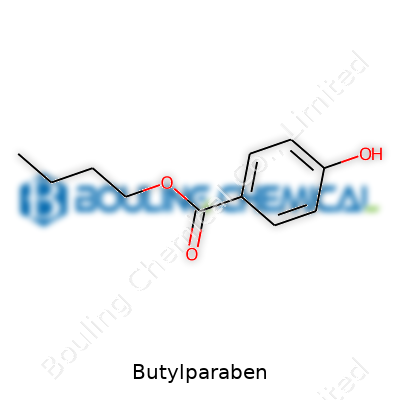
Butylparaben stands out as a clear choice for preserving creams, lotions, shampoos, and food products. It takes a spot among alkyl esters of p-hydroxybenzoic acid, distinguished from its methyl and ethyl siblings by a longer carbon chain which imparts stronger fungistatic effect. Those who work with raw materials daily know the exact granular feel and the distinct mild odor that helps verify product identity upon arrival. Unlike many synthetic additives, butylparaben holds its stability through various environmental and storage stresses—its utility survives heat cycles and months on the shelf.
Physical & Chemical Properties
Our technicians handle butylparaben in pure white crystalline or powder form, rarely encountering clumped or yellowed material unless moisture intrudes, which our storage protocols prevent. Melting point stays reliably near 68–70°C, and the compound barely dissolves in cold water, though alcohol and ether quickly take it into solution. The molecule’s aromatic ring bridges both organic and inorganic media, and the butyl substituent influences preservation spectra, giving protection in challenging fermentation-prone matrices.
Technical Specifications & Labeling
Every box leaving our facility reflects countless hours of method validation and analytical calibration. Industry-standard purity runs at a minimum of 99%, confirmed by HPLC and mass spec. Impurities and residual solvents sit comfortably below regulatory thresholds. We imprint batch numbers, expiration dates, and recommended storage conditions directly on packaging to eliminate ambiguity during routine audits. We expect any partner evaluating our butylparaben to easily match incoming test results against certificates, supporting seamless supply chain documentation. We keep all labeling in line with legal frameworks across different jurisdictions, especially as ingredient lists draw increasing regulatory and consumer attention.
Preparation Method
Butylparaben synthesis begins with the esterification of p-hydroxybenzoic acid using n-butanol as the alcohol component. We deploy an acid catalyst, most often sulfuric acid, under carefully controlled temperatures to optimize yield and suppress side reactions such as ether formation. Our engineers track water removal, driving equilibrium toward complete esterification. Filtration and recrystallization complete the process. Trace byproducts receive removal through washing and sequential purification until the product meets pharmaceutical or cosmetic-grade criteria. We never cut corners here, because the process consistency ensures both efficacy and safety downstream.
Chemical Reactions & Modifications
Beyond its value as a preservative, butylparaben presents a useful synthetic intermediate in research and specialty chemical formulations. Reactivity targets the ester moiety and phenolic hydroxyl; hydrolysis splits the compound into p-hydroxybenzoic acid and butanol, a characteristic exploited in metabolic and biodegradation studies. Researchers sometimes derivatize the compound's aromatic ring for tracing or for producing custom preservatives with tailored solubility or spectrum. Given increasing interest in paraben metabolism, our R&D regularly tests products for possible breakdown or binding in complex matrices, driving incremental improvements in manufacturing and analytical reproducibility.
Synonyms & Product Names
Each receiving manager and procurement officer encounters butylparaben under a variety of names, with “butyl p-hydroxybenzoate” and “butyl 4-hydroxybenzoate” appearing in both scientific and trade circles. Globally, the European Union prefers the E number E209 on food ingredient lists, while the US Pharmacopoeia designates it as Butylparaben, NF. Awareness of these synonyms helps avoid miscommunications during contract negotiations and cross-border shipments, especially when customs or import checks involve ingredient scrutiny.
Safety & Operational Standards
We keep industrial operators and the environment safe by enforcing meticulous handling guidelines. Direct dermal or inhalation exposure gets minimized through closed powder transfer, extract ventilation, and personal protective equipment; in over three decades of operation, adherence to these protocols has kept incident rates low. We educate every staff member on spill response, incompatible substances, and air quality monitoring to ensure ongoing compliance, as authorities such as OSHA and REACH require stringent documentation for hazardous materials. Routine review of globally harmonized safety data sheets backs up our claims. As a direct manufacturer, keeping these standards above regulatory minimum limits long-term liabilities.
Application Area
A large share of our customer base comprises personal care and cosmetic makers seeking assurance their emulsions and solutions remain microbially stable throughout intended shelf lives. Butylparaben covers fungi and yeasts especially well, making it a frequent inclusion in anionic formulations, hair care, and skin cleansers. Outside beauty aisles, food technologists value its resistance to spoilage in processed meats and baked goods—not only for regulatory compliance but for real world reductions in adverse quality complaints. Industrial lubricants and adhesives occasionally use this preservative to prolong storage or transport duration. We field requests from niche research teams seeking high-purity butylparaben for assay controls in environmental and health risk studies.
Research & Development
Each production run inspires feedback and process refinement. Our R&D teams collaborate with third-party laboratories on developing new analytical standards, especially as trace detection reaches ever-lower ppm thresholds in consumer goods. Much ongoing research focuses on alternatives to single-molecule preservatives, driving us to formulate blends that respond to regulatory trends and emerging microbial resistances. Safety endpoints, environmental fate, and degradation kinetics drive work on product dossiers—which we update in coordination with industry bodies. Staying transparent about our manufacturing process opens the door to academic partnerships for in vivo and in vitro validation.
Toxicity Research
Recent decades saw a swell of concern over parabens based on their potential to act as endocrine disruptors, prompting manufacturers to stay vigilant in evaluating developmental and chronic toxicity. Our review of toxicology data consistently guides decisions about permissible exposure limits and contaminant controls within the plant. Studies indicate low acute toxicity in oral, dermal, and inhalation models, but we maintain surveillance programs in line with the most conservative risk assessments. Regulatory agencies periodically review new findings, compelling us to adapt safety procedures and to communicate transparently with downstream customers, especially for leave-on personal care products that contact human skin daily. We invest in ongoing training so our teams remain aware of limits and obligations.
Future Prospects
As scrutiny on legacy preservatives intensifies, our role as a direct producer means we closely watch both regulatory currents and public sentiment. We see opportunity in synthesizing analogs with improved safety margins, as well as in enabling novel delivery systems that employ butylparaben in microencapsulated or slow-release forms. We expect future growth in food packaging and biomedical applications, contingent on further assurances of both efficacy and environmental compatibility. The core lesson from recent industry shifts remains this: direct knowledge, traceability, and willingness to adapt set manufacturers apart, especially as new scientific insights reshape market expectations. At every step, keeping our science transparent and our commitments public defines trust with partners and consumers alike.
Understanding the Real Role of Butylparaben
Butylparaben gets a lot of attention, and not always the good kind. From the inside of a chemical manufacturing plant, we know exactly how and why it’s added to so many consumer and industrial products. The real story isn’t about trends or buzzwords. It’s about practical chemistry, process needs, and experience earned over years of doing the work.
Preservation Isn't Guesswork
Making products last takes more than just good intentions. Microbial contamination ruins shelf life, safety, and reputation. Butylparaben steps in as an antimicrobial that targets bacteria, fungi, and mold. From my own work on formulation projects, I’ve seen how a few grams of butylparaben stop entire batches from spoiling during storage or transit. Lot recalls drop and shipping delays aren’t caused by ruined goods. You can’t rely on hope or untested alternatives when product consistency and safety exist on the line.
Key Uses in Personal Care and Pharmaceuticals
Cosmetic labs have built formulas around butylparaben. Lotions sit in warm bathrooms, shampoos drag along to gyms, and creams pass from person to person. Thanks to this chemical, those jars come out the other side without foul odors or visible growth. Outside of claims, our technicians regularly run stability and contamination tests; batches preserved with butylparaben outperform most other formulas—this matters to both brand owners and end-users.
Pharmaceutical manufacturing needs even tighter control. Eye drops, topical creams, and oral suspensions don’t always find their way into the refrigerator. Butylparaben gives formulators a robust tool to keep active compounds stable and free of dangerous microbes without significant shifts in taste, texture, or color. The alternative would be far higher preservative loads, which means unwanted reactions or consumer complaints.
Food Contact: Limited, But Sometimes Essential
Direct addition to foods stays limited by regulations, but butylparaben plays a supporting role in some indirect food contact materials, like coatings or adhesives. Here, the goal is simple: prevent mold on packaging that stores bread, cheese, or cured meats. Consistent quality minimizes wastage and keeps materials usable for longer.
Safety, Scrutiny, and Improvements
No chemical can claim zero controversy. Our process engineers pay close attention to safety data and regulatory updates. Oversight agencies regularly evaluate permissible levels in personal care and food packaging. Operators at our facilities undergo strict training, and constant monitoring ensures handling stays well within accepted limits.
Markets sometimes demand change. Some clients want “paraben-free” labels, and newer preservatives have started to take some of the load. We run tests with these whenever possible, but replacing butylparaben wholesale often means shorter lifespans, more product recalls, or increased preservative concentrations. These are trade-offs that come with real-world costs—not just for us, but for every business using these goods.
Looking Ahead: Responsible Manufacturing and Real Outcomes
While headlines can stir debate, our job is to keep goods safe, practical, and reliable. Experience shows that butylparaben, when used carefully, strikes a balance between performance and manageable safety risks. As manufacturers, we put in the work behind every batch—scrutinizing each step, refining our processes, and listening as markets and science evolve. The end-user might never know the name or the work that happens upstream, but safe, fresh, and effective products remain the clearest measure of its value.
A Manufacturer’s View on Butylparaben in Personal Care
Ask many formulators in the cosmetics industry what keeps products shelf-stable, and butylparaben enters the discussion quickly. This preservative has anchored itself in creams, lotions, shampoos, and makeup for decades. As the producer, our focus always lands on how a substance acts through each stage—from mixing in the tank to the final user’s hands. Skin safety questions deserve real answers grounded in production knowledge and science, not marketing spin or internet fear.
Butylparaben belongs to the paraben family, a group of compounds that curb microbial growth. Fungi and bacteria thrive in moist, nutrient-rich environments, making personal care formulas prone to spoilage. Without a chemical preservative, products can become contaminated long before their expiration date, raising real risks of infection and unreliable performance. Having worked through countless batches on the production line, microbial control sits high on the priority list.
Some news stories and social discussions point at parabens with suspicion. There are claims about hormone disruption and possible links to health issues. Our manufacturing protocols always rely on hard evidence and regulatory review rather than rumor. Regulatory scientists review studies on butylparaben’s use levels and any effects seen at regular exposure. At the concentrations used in cosmetics, global scientific panels—like those from the US, EU, and Japan—have set legal and safe limits. These agencies examined data from cell studies, animal models, and human trials. Current consensus states that butylparaben remains safe in the regulated amounts present in personal care products. The European Commission restricts its level to below 0.14 percent, which matches consumer safety data on absorption and breakdown in the body.
In the factory, we follow these limits without exception. Our ingredient suppliers test for quality, and every batch faces analysis for concentration and purity. If butylparaben exceeded regulatory thresholds, quality control would catch it long before leaving the plant. This vigilance forms the backbone of responsible chemical manufacturing. Only years of hands-on technical experience produce this type of attention to detail, from raw material selection down to final packaging and distribution.
Skin sensitivity does vary, though, and some people may show reactions to certain ingredients—preservatives included. Parabens show a low rate of allergic response, much lower than newer preservation systems sometimes marketed as “cleaner.” Often, our company hears from brands considering switching preservatives, only to return to parabens after facing higher recall rates or shorter shelf life. Replacing butylparaben without a proven alternative brings challenges, as not every substitute matches its proven safety record and long-term stability. Jumping on every new trend means running technical trials, shelf-life tests, and safety checks for months or years. These steps keep consumer protection at the center.
Ongoing debate pushes everyone in the industry to keep evaluating data. As a manufacturer, we stay transparent about ingredient sourcing and use rates. We encourage more consumer education, not alarm. Trust in personal care products depends on careful science, regulatory oversight, and honesty about manufacturing standards. Respect for consumers shapes every stage of production. Supporting fact-driven discussion on butylparaben safety—grounded in decades of scientific review—carries responsibility for us all working in this field.
First-Hand Experience Meets Public Concern
As a producer of butylparaben for over a decade, we’ve fielded a lot of questions from clients and regulatory auditors about its safety profile, especially its potential to cause skin allergies or irritation. These questions often resurface as consumer interest rises in ingredient transparency and “free from” product claims. The concerns are valid—nobody wants a preservative that triggers discomfort or hypersensitivity in end users, whether in cosmetics, personal care, or pharmaceuticals.
Understanding Butylparaben in Context
Butylparaben belongs to the paraben family, which companies have used since the 1920s as preservatives to inhibit the growth of bacteria and mold. This function is key in water-based products that would otherwise spoil rapidly. Regulators across Europe, North America, and Asia have studied parabens, including butylparaben, for decades to monitor any health risks.
Most allergic reactions linked to butylparaben enter the conversation because individuals with already sensitive skin have an increased likelihood of developing contact dermatitis. Across thousands of tons we’ve supplied for consumer goods, only a small fraction of end-user reports involve allergic or irritant responses—and these tend to cluster in populations with known sensitivities to multiple ingredients, not just parabens.
What the Data Shows
Clinical safety reviews published by independent research bodies and regulatory agencies indicate a low rate of skin reactions to butylparaben at levels used in finished products. For instance, the European Commission’s Scientific Committee on Consumer Safety has scrutinized existing data and allowed butylparaben up to 0.14% in ready-to-use cosmetic products, based on a strong safety margin.
We monitor both raw material quality and downstream impact. Even minute traces of impurities—arising from improper synthesis or storage—can skew test results and trigger irritation. Audits of consumer feedback and adverse event registrations consistently show that butylparaben does not rank high on the list of common cosmetic allergens, in contrast to fragrances or some natural extracts. Researchers at hospitals and universities have repeatedly reported that other preservatives, like methylisothiazolinone, carry significantly higher risks for allergic contact dermatitis.
Direct Handling Experience
Since we often formulate sample bases ourselves, our technical and lab teams remain attentive to the delivery form, pH compatibility, and solubility. During handling at the factory and during pilot-scale batch tests, staff rarely comment on irritation, provided standard protective practices are followed for all fine chemicals. Bulk exposure to undiluted butylparaben—well above concentrations in consumer products—offers limited but valuable insight into occupational safety, and our track record aligns with published literature: direct irritation does not occur unless there’s prolonged or careless contact.
Challenges and Solutions in Manufacturing
Despite a robust safety record, public perception sometimes shifts on the basis of anecdotal reports or misinterpreted research. Reducing uncertainty helps clients choose the right preservative system: we share technical bulletins with product formulators, offering transparent answers to questions about allergic potential. We also conduct stability and compatibility studies, which catch product-specific triggers that would otherwise go unexplored.
Substitution with alternative preservatives has become more popular as brand positioning changes, but alternatives usually bring their own performance or reaction risks. Sticking with well-understood ingredients, backed by open access to both regulatory safety limits and material test data, gives customers a clear path forward.
Understanding the Status of Butylparaben
Parabens have stirred public debate for years. In our work producing butylparaben for industrial clients, we see policy changes ripple out in real time. Cosmetics manufacturers often reach out and ask directly: Is butylparaben cleared for use, and under what conditions? We keep a close eye on regulations in all export markets because these decisions impact both our production schedules and our customers’ formulas.
Regulation Across the Globe
The use of butylparaben, like many cosmetic ingredients, depends heavily on jurisdiction. In the United States, the FDA permits butylparaben in cosmetics, but only at low levels. Unlike some countries, the FDA doesn’t mandate pre-market approval for cosmetic ingredients. It instead places responsibility on manufacturers to ensure product safety. For many years, we worked with cosmetics companies who routinely test and monitor for total paraben content.
In the European Union, regulations have tightened, but butylparaben still appears on the approved list. Updates to the Cosmetics Regulation (EC) No 1223/2009 capped the combined level of certain parabens, including butylparaben, at 0.8% in finished products or 0.19% for any single paraben. These numbers are always front of mind when preparing batches for export. Our tanks and weighing stations stay equipped for trace-level precision because exceeding limits leads to costly recalls, not to mention potential harm to end users.
Japan, Canada, and Australia also allow butylparaben under set concentration limits. Local clients often request fresh documentation to prove compliance, especially after high-profile news stories reignite consumer concern. Every batch leaves with a full certificate of analysis; we know consumer trust rises and falls with transparency.
Why Butylparaben Remains Relevant
Several preservatives once filled shelves, but few offer the stability and broad-spectrum protection butylparaben delivers. Microbial growth doesn’t care about public perception—poorly preserved products can trigger outbreaks or financial disasters. Years ago, we helped a small skincare brand trace a recurring mold issue to an insufficient preservation system. Switching to a paraben-based solution, in compliance with local laws, solved contamination and slashed returns nearly overnight.
Still, questions persist about safety, despite decades of data and widespread regulatory review. Multiple independent panels, including the Cosmetic Ingredient Review (CIR), evaluated the evidence and found current cosmetic concentrations safe. As a manufacturer, we support ongoing scientific review and keep contingency plans for reformulation. We invest in cleaner processing and thorough purity testing, both out of pride and necessity.
Future Considerations and Solutions
As demand grows for “paraben-free” products, we see clients looking for alternatives even in markets where butylparaben is still authorized. Some choose natural preservatives, but these often come with drawbacks—limited shelf life, higher costs, or increased risk of product spoilage. Education helps manage expectations: not every formulation can forgo synthetic preservation without trade-offs in safety or performance.
Direct dialogue with regulatory bodies, regular batch testing, and continual review of emerging toxicology research have become standard practice for us. Monitoring shifts in policy lets us pivot swiftly, minimizing waste and keeping client trust. Safety and compliance aren’t marketing slogans here; they’re built into every shipment leaving our facility.
The Realities of Butylparaben Use in Industry
Butylparaben has a long function as a preservative in cosmetics, pharmaceuticals, and even some foods. In the production plant, workers handle it every day and know both the safety protocols and the realities behind internet debates and regulatory reviews. Debates about parabens shift constantly, but sticking to evidence and real-world practices helps clear the air.
The Science Behind Side Effect Concerns
Most concerns surrounding butylparaben link to its role as an endocrine disruptor. Some animal studies suggest high concentrations could mimic estrogen, which sounds frightening at first glance. Laboratories often use doses much higher than what appears in a finished shampoo or moisturizer. Plants producing butylparaben work within industry safety standards, and permitted levels remain far below those found to trigger hormonal effects in test animals.
Contact allergies make another common point of discussion. Over a career formulating batches, one rarely encounters severe reactions among workers involved in manufacturing, provided proper gloves and respirators are worn as required. Finished products contain but a tiny fraction of the compound. Regulatory checks support these practices, and rates of skin irritation remain extremely low for the population at large. For comparison, fragrance ingredients and certain dyes found in similar products cause allergy complaints far more often.
Why Production Controls Matter
Manufacturing facilities design strict procedures for weighing, mixing, and packaging. Automated systems help keep worker exposure below occupational limits. Air monitoring and regular health surveillance programs play a crucial role in ensuring that exposure never exceeds what authorities recommend. From long-standing experience, those who work around the chemical daily see little evidence of widespread side effects under proper controls.
Much of the online worry around butylparaben comes from mixing up hazard and actual risk. Nearly anything can pose a hazard at high doses in laboratory conditions. The risk depends on concentration, exposure route, and duration. Every shift, production teams recalibrate dosing systems to keep levels consistent, never exceeding regulatory guidelines. Products reach the market only after passing rigorous quality control testing, including purity and contamination screening.
Regulatory Scrutiny and Industry Response
Authorities such as the European Commission and the US Food and Drug Administration have periodically reviewed butylparaben use. They set clear concentration limits for different product types and revisit these thresholds as more scientific data emerges. This forms a transparent framework that responsible manufacturers follow to the letter. If new research ever suggests a safety concern at approved levels, the industry adapts swiftly, switching ingredients or reformulating products. Factories modify production lines and supply chains in response to these shifts, sometimes at significant cost, but public and worker health always take priority.
Continuous Improvement for Safer Products
Processes evolve year after year, guided by new findings and regulatory adjustments. Modern chemical plants invest in training programs and new technology, both for worker safety and for consumer peace of mind. Substituting lower-risk preservatives or designing new blends sometimes requires extra research and money. Still, market demand for transparency and enhanced safety keeps pushing innovation forward, even if that means revisiting legacy formulations.