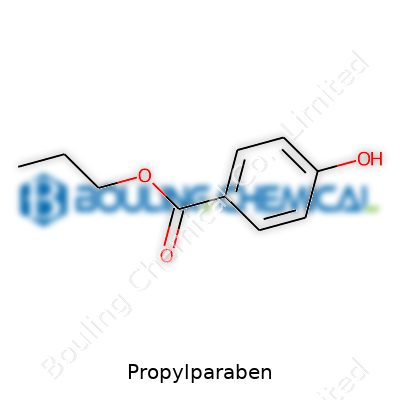
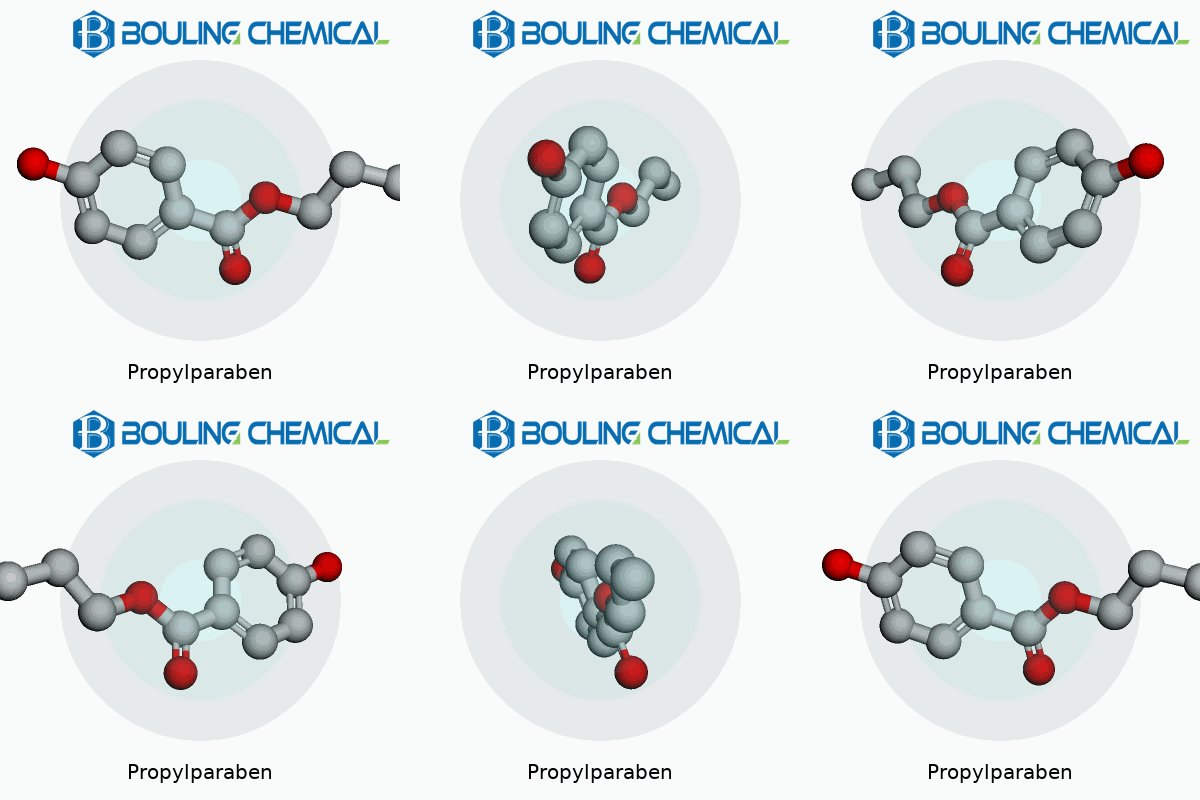
Propylparaben: Reflections from the Production Floor
Historical Development
Customers throughout the supply chain often take for granted the path that everyday preservatives travel before reaching the marketplace. Propylparaben’s story began nearly a century ago as scientists recognized the need to prevent spoilage in food and pharmaceuticals as populations and production volumes rose. Early on, the complications of microbe control forced flank solutions like salting, smoking, or heavy dosing of benzoates. Propylparaben’s rise came from a decisive moment in organic ester chemistry—when the reaction between parahydroxybenzoic acid and alcohols became well-controlled at the industrial scale. As both a chemical manufacturer and a steward of this legacy, we have witnessed successive regulatory, technical, and perception shifts. Before the 1970s, few considered consumer sensitivity or long-term biological impacts. Progressive demands for both safety and performance forced reevaluation of raw materials, batch processes, and quality control.
Product Overview
Propylparaben—systematically known as propyl 4-hydroxybenzoate—gets integrated into products that must maintain stability under a variety of storage and environmental conditions. As a producer, we ship tons of this substance to pharmaceutical, personal care, and food companies in multiple continents every year. While parabens as a group have drawn attention for endocrine disruption debates, widespread acceptance around the globe owes to nearly unmatched antimicrobial protection abilities at low concentrations. Unlike sorbates or benzoates, propylparaben’s effective range stretches through pH environments typical of creams, syrups, and low-acid edibles, which fills a vital gap for formulators. Our focus has always been on delivering uncontaminated, consistently reactive batches; we’ve seen firsthand how even slight impurities can compromise preservative function, encourage regulatory questions, or create downstream processing delays.
Physical & Chemical Properties
In solid form, propylparaben presents as an odorless white powder. Its melting range sits comfortably around 96–98°C and it dissolves readily in alcohol and ether but less so in cold water. These facts are well-known, but working day after day in production, we have come to appreciate the nuisance water content brings to granule handling. Even minor atmospheric humidity can cause agglomeration or caking, affecting downstream dosing accuracy. Chemically, propylparaben functions as a simple ester, subject to hydrolysis in high heat or very alkaline settings, and the presence of water during storage or shipment has a real-world impact on shelf life. Pure lots require specialized handling and protective packaging to maintain stability during global transport.
Technical Specifications & Labeling
Customers and regulators expect clear, validated data. Whether destined for a pharmaceutical excipient or a food preservative, propylparaben must meet pharmacopoeial standards for purity (often greater than 99%), controlled moisture (under 0.5%), and low heavy metal content. Our analytical team spends countless hours running HPLC purity checks, IR spectra, and confirming microbial absence. Regulations continually change, including EU directives and US FDA rulings, which ripple back to line labeling, COSHH, and traceability demands for every shipping unit. Correct CAS number, batch information, and hazard language, updated to the GHS framework, are part of our weekly compliance culture. Labels often travel through multilingual, multi-standard regions, so we design and print under layers of review.
Preparation Method
The process itself relies on esterification—combining purified p-hydroxybenzoic acid with propanol, using an acid catalyst under reflux. Decades ago, yields often failed to top 70%. Over time, continuous feed reactors, precise temperature ramps, and powerful vacuum evaporation brought conversion rates to rival those of solvents with higher boiling points. Today, clean distillation of the crude ester, aggressive drying, and gravity-controlled milling all cascade within a tightly monitored batch system. During scale-up phases, we identified controlling the molar ratio and rapid neutralization as critical to maximizing output and minimizing byproducts like colored impurities. Energy recycling and reduced reagent use have become factory standards and point toward leaner production economics without sacrificing reliability.
Chemical Reactions & Modifications
Once produced, propylparaben provides a flexible base for further modification. Hydrolysis splits it back into parent acid and alcohol, while transesterification gives access to other alkyl parabens on demand. Customers use these reactions to create blends tailored for dual-preservative effects or as intermediary steps toward more specialized derivatives. We often get requests for propylparaben sodium salt—offering increased water solubility for clear liquid products. These modifications use our propylparaben as a starting point, and overseeing their execution has led us to develop analytical tools for confirming complete conversion while preserving the original molecule’s protective function.
Synonyms & Product Names
Propylparaben’s nomenclature can create headaches for technical and regulatory teams. Pharmacopeias list it as propyl 4-hydroxybenzoate, E216, nipasol, and myriad brand or system labels. Over the years, confusion over similar-sounding names or relaxed synonym use led to mislabeling or rejection events at customs. We enforce strict synonym and language control across all documentation and digital systems to reduce error, and we’ve spent hours with international clients clarifying which codes and aliases map to their requirements. An untidy synonym list exposes risk and fosters regulatory friction in global trade.
Safety & Operational Standards
The roots of our safety culture run deep because opportunities for error grow with throughput. Propylparaben earns an irritant label, with dust capable of causing respiratory and skin reactions. We train all operational staff on dust extraction design, correct PPE, and chemical containment protocols—lessons learned from prior exposure events in our early years. On a broader level, evolving hazard assessments have driven us toward ongoing focus on air quality, trace batch retention, and environmental discharge controls. End users trust chemical manufacturers to respect occupational health, and this starts with constant vigilance on the production floor.
Application Area
Propylparaben stays relevant in diverse fields. It anchors the microbiological stability of ointments, creams, and eye drops where patient health leaves little room for error. In cosmetics, its resilience through pH swings lets brands offer longer shelf lives without spoilage complaints. Food technologists opt for propylparaben in moisture-prone baked goods and syrups where less persistent preservatives fail. As a supplier dealing with requests from bakery, canned fish, toothpaste, and hospital drug manufacturers, we see the essential role this compound plays. It prevents hundreds of tons of product loss each year and staves off recalls caused by microbial outbreaks.
Research & Development
Long-term survival in the chemicals sector depends on R&D that adapts to market and regulatory shifts. In-house teams at our plant spend months reviewing structure-activity relationships, synthesis route improvements, and options for greener, less solvent-intensive reactions. Anticipating questions from authorities about micron-level residues drives analytical method development. We have participated in collaborative university studies mapping the interaction of parabens with novel antimicrobial agents, hoping to enlarge the defense against pathogens. Cutbacks in R&D all too often travel downstream until a customer’s urgent need exposes the lack of innovation; in this sense, the best safeguard is relentless technical curiosity.
Toxicity Research
Toxicologists continue to scrutinize propylparaben, examining links to hormone activity and potential cumulative effects. Debates over estrogenic impact brought new rounds of studies and safety assessments. From the manufacturing side, we provide maximum transparency for impurity profiles, particulate risks, and typical residual solvent levels so that stakeholders can interpret toxicological findings with confidence. Our lab team frequently engages with external toxicology groups, contributing batch samples for in vitro or animal model studies and staying alert to authorities requesting new toxicological endpoints. Responsible production stays ahead of the science, not behind.
Future Prospects
Both opportunity and threat shape our outlook for propylparaben in the decades to come. Regulatory standards keep inching forward, so production operations face constant review for trace impurities, greener process options, and renewable-sourced feedstocks. Brand holders in the personal care sector push harder for “clean label” alternatives, though many still turn to parabens after “natural” preservatives fail under pressure. We invest in process optimization, waste minimization, and developing functionally equivalent substances using safer reagents and lower resource inputs. New medical applications—such as heat-sensitive biologics needing extended shelf life—create space for reformulated or encapsulated propylparaben. We take the lessons of nearly a century’s work seriously: every year brings changes, but robust chemistry, transparent operations, and technical partnership keep propylparaben embedded at the frontline of product protection.
How Propylparaben Earned Its Place in Chemistry
Making chemicals for daily life means balancing performance, reliability, and public trust. Many people know propylparaben by name, but the real story begins in our mixing halls, where a solid understanding of preservation is worth its weight in gold. Most production lines face the same old enemies—bacteria, yeast, and mold. Once these microbes take hold, batches spoil, raw materials get wasted, and companies land in hot water over product safety. There’s no shortage of preservatives on the market, but propylparaben stands out for anything destined to be in close contact with human skin or consumed in trace amounts.
The Role of Propylparaben in Preserving Everyday Products
We first saw demand for propylparaben surge decades ago, thanks to its gentle nature and broad antimicrobial reach. In the factory, propylparaben goes into all kinds of personal care products—lotions, creams, shampoos, and conditioners. Cosmetic companies trust it because it can stop mold and bacteria growth at low concentrations, even when packed into high-moisture formulations. If you’ve ever stored a moisturizer in your bathroom cabinet and returned to find it as fresh as the day you bought it, propylparaben probably played a role.
Food preservation forms another major application. It shows up in baked goods, processed cheeses, and syrups, keeping them fresh for weeks rather than days. Since the food world faces strict regulations about additive safety, manufacturing propylparaben demands tight quality controls and clean conditions every step of the way. One slip in purity, and a shipment might get rejected or trigger a recall. We run repeated purity tests and trace every drum to its raw material lot, not just for compliance but out of professional pride.
The Safety and Misunderstandings Around Propylparaben Use
Ask any plant manager and you’ll hear the same: misinformation can cause more headaches than any process hiccup. Online debates over paraben safety sometimes paint a dire picture, but robust studies back up the safe use of propylparaben in low concentrations. Regulators in the US, EU, and elsewhere regularly review the science, weighing human exposure, breakdown in the body, and real-world risk. We follow those evolving standards, not only to follow the rules but to keep the trust of partners and end users. It becomes second nature after a while—to question our own assumptions, audit our process, and invest in raw material traceability.
Challenges and Solutions for Manufacturers
Odd as it sounds, producing propylparaben without adding unwanted impurities isn’t as trivial as it might look. We invest in clean feedstocks and focus on reaction control. Any supplier that cuts corners—cheap solvents, leftover residue, cross-contaminated tanks—jeopardizes the entire supply chain. Trace metal ions, if overlooked, can trigger degradation or off-odors in the final product. That’s why you’ll find real-time monitoring and periodic cleanup routines across reputable plants. Our lab techs know that tight processes mean fewer headaches later, both on the production line and in the headlines.
Alternatives keep entering the scene, from plant extracts to next-generation preservative blends. Not every newcomer matches the stability, safety, and predictability of propylparaben. Keeping our ingredient in and out of the news hinges on transparency—sharing what we use, why we use it, and how we keep it safe. Labs, technicians, operators, and managers all play a part in maintaining that standard.
Looking Forward
Propylparaben’s reputation has weathered trends and fads because it does what’s needed to protect products that people reach for every day. Our role as chemical manufacturers involves more than barrels, batches, and blending—it’s about advocating for well-made solutions with nothing to hide. Responsible use, strong safety data, and process discipline have kept propylparaben relevant. That same vigilance will shape its future in the hands of those who know it best.
Experience from the Factory Floor
Formulating a safe and stable personal care product requires more than theory. In our manufacturing line, preservative choice can make or break a batch—literally. Years of watching products go from raw ingredients to finished bottles leaves no doubt: without suitable preservatives, cosmetics give microbes a free ride. Propylparaben enters here. This compound has stopped countless molds and bacteria in their tracks, protecting creams, lotions, and shampoos all the way from filling room to the customer’s bathroom shelf.
Regulatory Oversight and Safety Testing
Regulatory bodies keep a close eye on ingredients. Propylparaben has passed scrutiny from agencies such as the US Food and Drug Administration and the European Commission’s Scientific Committee on Consumer Safety. Each sets strict usage levels—usually no more than 0.14% in ready-to-use cosmetic products. These limits do not spring up by accident. Toxicologists have run dose studies, checking repeat exposure, skin absorption, and potential hormonal activity. Under the current guidelines, propylparaben remains within margins well below established risk thresholds.
Human safety data weighs heavily in these assessments. Decades of use and monitoring turn up no solid evidence of widespread adverse effects from propylparaben at allowed concentrations. In the factory, product stability tests and real-world sample checks back up the official numbers. Finished products reach store shelves only after passing microbial challenge tests—preservatives like propylparaben deliver the protection needed for those results.
Concerns About Endocrine Activity
Some news outlets spotlight animal studies linking certain parabens to weak estrogenic effects at extremely high doses. In the lab, our own team has pored over this research. The crucial point: rodent tests often use concentrations far above real-world exposure. Formulators in the industry do not load products with parabens anywhere near those doses. Multiple regulatory reviews have reached the same conclusion—propylparaben in consumer products does not pose an endocrine disruption concern based on current data. As a manufacturer, each batch is kept well below global safety levels, following the latest research and legal standards closely.
Potential Alternatives and Manufacturing Realities
Switching preservatives isn't as simple as swapping ingredients on a label. Few other compounds fight a broad range of microbes as effectively as parabens, all while causing so few allergic reactions. Some newer preservatives break down more quickly or irritate skin at legal concentrations. Trials to replace propylparaben with “natural” blends turn up problems—products spoil sooner, separation occurs, or molds slip through. Real-world demands from customers and retailers make it difficult to ignore what works best for a broad population.
Putting Consumer Safety First
In production, every preservative decision gets run through multiple checkpoints—to protect both the end user and the brand’s reputation. Propylparaben continues to earn its place because it balances product protection with a long track record of safety at legal doses. Regulators update recommendations as new science comes in. On the factory floor, we pivot as needed, investing in reformulation and testing to match those shifts. For now, science and experience both line up in favor of propylparaben as a reliable choice for keeping cosmetics and personal care products safe, stable, and enjoyable to use.
What Decades of Making Propylparaben Teach Us
Every batch of propylparaben we produce passes through strict quality control. We use precision to keep consistency high. As manufacturers, we have followed developments in product safety, scientific findings, and consumer sentiment with close attention. Customers—cosmetic companies, pharmaceutical makers, food packagers—raise questions about side effects and allergies more often, especially as awareness around preservatives grows.
Understanding the Real Risks
From our vantage point, allergic reactions to propylparaben remain rare. Multiple published studies and surveillance results support this. Industrial safety reports and medical journals put sensitization rates for parabens at less than one percent among the population, even in people who use paraben-containing products daily for years. In our own facility, we train our technicians for safe handling, though propylparaben falls within the least problematic category of synthetic preservatives for skin exposure.
Our customers' feedback offers a practical angle beyond statistics. During large-scale use in soaps, lotions, and creams, only a handful have reported mild adverse effects like redness or itching. True allergic contact dermatitis linked directly to propylparaben seldom appears in dermatology clinics according to published records. Often, formulations contain several ingredients, making it trickier to pin down the real trigger. That’s why patch testing by healthcare professionals is so important. Real-world numbers keep the conversation honest and avoid stoking unnecessary concern.
Side Effects Beyond Allergies
We see questions about hormone disruption tied to parabens come up more often than allergy concerns. Studies suggest the estrogenic activity of propylparaben is very weak—much less than natural phytoestrogens common in food and drink. Regulatory agencies in the European Union, United States, and Japan reviewed this research. Each still allows propylparaben in personal care products under clear limits: the science supports safety at those levels. Regulatory changes, such as stricter concentration caps, reflect ongoing vigilance rather than conclusive new risk. Responsible manufacturers adopt these adjustments promptly.
Approaching Sensitive Groups and Product Formulation
In product development meetings, we encounter specific concerns for vulnerable groups such as babies, children, or those with a history of atopic dermatitis. Decisions involve not just adherence to law, but good judgment—choosing the right preservative system for the intended user. Some brands opt out of parabens entirely. Others use lower concentrations, often backed with additional skin compatibility testing. We collaborate, openly disclosing origin, purity, and safety data.
Since people are unique, no ingredient—natural or synthetic—reaches total safety for every individual. Our role means raising awareness, not just touting safe records but sharing available scientific knowledge and pointing out that even "natural" preservatives bring their own risks. Propylparaben holds a long track record, but we continue to monitor new evidence and feedback from both end users and professional partners. Open science, clear labeling, and careful listening to genuine customer experience keep product safety at the forefront.
Regulatory Status Shapes Industry Practices
Our industry works closely with regulators worldwide, whether supplying the personal care sector or supporting food formulations. Propylparaben stands out as a widely used preservative. In practice, we track the stance of leading authorities like the US Food and Drug Administration (FDA), the European Food Safety Authority (EFSA), and similar bodies across Asia and elsewhere. Within the United States, propylparaben appears on the list of substances generally recognized as safe (GRAS) for certain food applications. The FDA specifically authorizes its use in food up to set concentrations. Cosmetic chemists look to the same agency, and propylparaben can be found in toiletries, lotions, and makeup, always under the limitations spelled out by regulations.
Turning to Europe, authorities have laid out similar yet sometimes stricter rules. The EU’s Cosmetics Regulation establishes a maximum allowed concentration of 0.14 percent for propylparaben in finished cosmetic products. Collective safety assessments, published by the Scientific Committee on Consumer Safety, keep manufacturers on their toes regarding new findings around human health. If safety profiles shift, manufacturers get clear signals and adjust formulas accordingly. Regulators place prohibition or restriction on certain uses to respond to new science, particularly when it comes to sensitive populations like infants.
A manufacturer spends considerable resources ensuring compliance. It’s not enough to reference these guidelines once and step back. We routinely review new opinions from oversight agencies. When Japan or South Korea refreshes its allowable thresholds—or if California introduces state-level rules—our technical teams review batch specifications, update regulatory document packets, and retrain operators on any needed changes. Real compliance blends good science with solid training and operational flexibility.
The Reality of Producing for Global Markets
Supplying propylparaben in bulk means more than achieving high-purity output. The material must meet every country’s specific requirements, or else shipments risk being quarantined or rejected. For instance, batch certification might demand detailed impurity data; at other times, proof of non-animal origin or absence of certain solvents forms the sticking point in the documentation process.
Quality assurance labs run full-spectrum analyses—residual solvent testing, purity, heavy metals, and stability under various temperature and humidity conditions. Documentation needs digital archiving so that it’s easy to pull historical lot data years down the line, if auditors or brand partners come knocking. This regulatory diligence creates trust in the entire value chain, from upstream raw material procurement to final delivery.
Addressing Concerns and Adjusting to Shifts
Concerns about parabens, including propylparaben, focus mainly on potential endocrine activity and accumulation effects. Governmental agencies continue launching multi-year reviews on the basis of laboratory, animal, and human studies. With each major study published, manufacturers face questions: Has the regulatory position changed? Is further risk evaluation required?
To respond, our risk assessment protocols include close reading of international guidance. If new risk management measures appear on the horizon, we prepare alternative formulations. Some customers prefer paraben-free labels, so research works on blends of organic acids, alcohols, or plant-based preservatives.
Approvals for propylparaben still remain robust in many jurisdictions, but we don’t consider regulations static. Maintaining safe, consistent, fully compliant product lines requires vigilance across borders and a commitment to transparency all the way down the supply chain.
Industry Perspective on Propylparaben and Its Role in Preservation
At our manufacturing site, we have produced propylparaben in large volumes for over two decades. The preservation of foods, cosmetics, and pharmaceuticals demands compounds that stand up to microbial challenges without raising safety red flags for consumers. No one here takes lightly the questions raised on hormone or endocrine effects. The science matters, and people deserve clear answers.
What the Studies Tell Us
Propylparaben belongs to the paraben family, a group of preservatives well known for stopping mold and bacteria. The structure of parabens shares some chemical similarity with naturally occurring plant estrogens. Bench scientists have measured their weak estrogenic activity in lab tests, which has led to scrutiny. In those controlled petri dishes or animal models, high doses sometimes activate estrogen receptors, but the potency falls many orders of magnitude below the human body’s own hormones. That context often gets overlooked.
Day-to-day in our facility, we focus on purity, dose accuracy, and good manufacturing practices, because we know real-world exposure differs from lab extremes. The bulk of independent safety reviews keep returning to the same point: people encounter propylparaben in such low amounts, the measurable effects on hormones in real life stand very close to zero. Regulatory bodies such as the European Food Safety Authority and US FDA have set strict usage limits and conducted thorough risk assessments, finding little cause for concern at typical usage levels.
Why the Concern Persists
Public concern doesn’t fade just because scientists call a compound “safe as used.” Endocrine disruption gets widespread attention, and rightly so, because many people mistrust the flood of modern chemicals. Our own staff talk about what they use at home and what goes into family products. We see every report and address questions from customers directly, instead of hiding behind jargon.
Media headlines often amplify findings from isolated cell studies or focus on controversial rodent work at doses no person would come close to encountering. These stories create understandable worry, but they don’t always match the data from human exposure or large epidemiological studies. If consistent, high-quality human studies pointed to hormone disruption from propylparaben, the conversation here would look very different.
Addressing the Challenges
From a manufacturer’s view, transparency and research matter more than slogans. We support continuous toxicological testing, open data, and robust exposure monitoring. Improvements don’t come from doubling down on tradition, but from adapting to valid new findings. Where feasible, we’ve refined processes to minimize residual content and hold ourselves to evolving regulatory benchmarks.
Alternatives may sound appealing, but some perform worse or present new, unknown risks. We’ve tested dozens of substitutes and keep a constant eye on novel preservation strategies. For every batch we produce, safety and compliance drive decisions. Our commitment remains: only ship what meets the highest technical and public health standards, and take public questions on chemical safety seriously each step of the way.